Month: August 2016

Bruce Conner Loves Sound (Part 2)

From Angels (1986) with Edmund Shea

In one visit, it is difficult to appreciate the welter of media, styles and experiences of Bruce Conner: It’s All True. Mandalas are framed and hung on the wall in one gallery- inked in minute, cramped detail. Intentional or not, it reminds me of the test patterns and countdowns that one often sees in his films. Those images make me “hear” the beeps and sine waves of the behind-the-scenes machinations of watching T.V. and movies as a kid. Sometimes the curtain would open and you would see and hear the wizard, or at least the technician, before the show started.
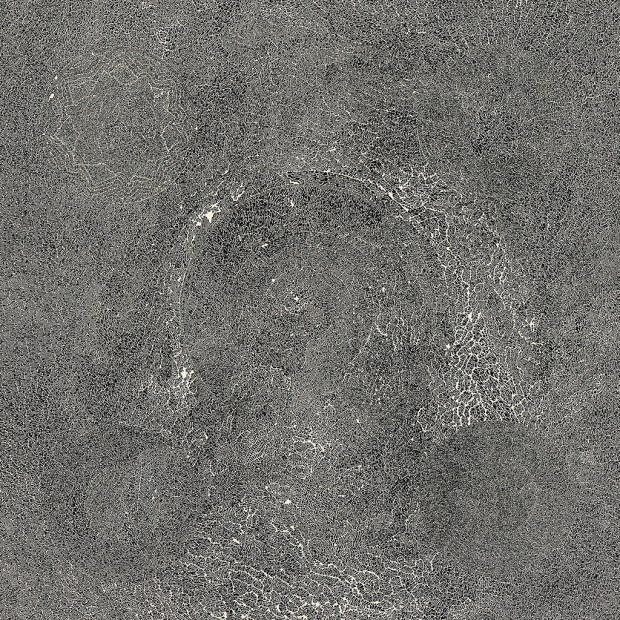
web_100-MANDALA

#100 MANDALA (1970)

hqdefault

1950’s  era television test pattern

Conner likes working with other artists.  Angels is one cooperative effort with Edmund Shea from 1986. The room for Angels is painted black and hung on the walls are several gelatin silver prints of heavenly light piercing a black plane. There are eight almost-full-sized portraits, each cutting through the dark in its own way. According to the information sign, Bruce liked making his gallery shows “theatrical”, so these images were originally accompanied by crickets in a box, chirping. MoMA shied away from this idea by playing a close recording of crickets into the gallery space. I guess bait shops and potato slices aren’t plentiful on 53rd street.


The chirping warms the room, accompanying the angels not with the sounds of  heavenly hosts, but with a summer night. The angels are made familiar by this friendly, earthy chorus. Angels is now associated in my mind with the sound of chirping crickets, and they are more alive in my memory. Clever how he attaches his angels to my memory with sound.

This is the second post of many about this exhibition. Please go! At MoMA until October 2nd.

Bruce Conner Loves Sound

Gregory Briggler at the exhibition. Photo credit: ©2016 Gregory Briggler

Bruce Conner loves sound. He understands it in a way that few visual artists do. The Museum of Modern Art (MoMA) is showing and sounding a retrospective of the artist whose life spanned the life of Rock and Roll. The name of the show is Bruce Conner: It’s All True. I can not recommend it enthusiastically enough.

Conner-A_MOVIE_girlie

A frame from A Movie

The main show begins fittingly with “A Movie” (1958) which impressed me with its aesthetic directness. Well known and respected (but new to me), the found-film collage swings back and forth between images of violence, love, beauty and the mundane. All accompanied by the orchestral brass warhorse “The Pines of Rome” (1924) by Italian composer Ottorino Respighi. The music begins with a quiet flourish and ends majestically, and the images seem to surf the music, harnessing its power in a brilliant way. It’s hard to imagine how the film would work without the music to lend structure and support. Conner often uses images, music and sound that look back in time, but the effect never strikes me as nostalgic or cheaply ironic.

File_000-2

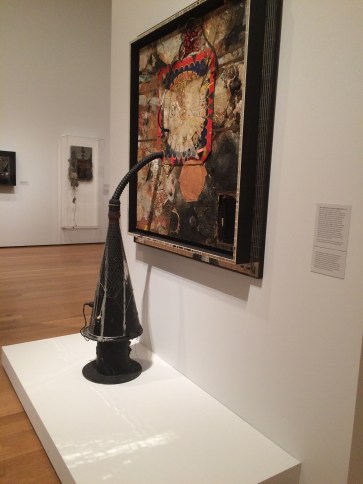
He uses sound as a part of collage in Tick Tock Jelly Clock Cosmotron (1961) (above) just as surely he uses nylon hose, wax and pin-up cutouts in other sculptures and assemblages from around the same time. In the original “Tick Tock” a vacuum cone containing the sound playback and recording device is umbilicaled to the rest of the collage. Inside the cone, he had originally recorded the conversations in the gallery, distorted them, and added them back to a pre-recorded track. The MoMA, out of fear of privacy lawsuits or laziness only plays the original ambient recording. You can hear a sample below. By the way, the cosmotron was a particle accelerator used in nuclear physics. He was obsessed with “the bomb” after all.

This is the first post of many about this exhibition. Please go! At MoMA until October 2nd.